The Inconvenient Truth About Born-Alive Abortions
Earlier this week Family First published government data showing that at least one child a month on average is surviving an abortion. A born-alive abortion. But despite their previous obsession with the overturning of Roe v Wade (they normally refer to abortion as an ‘imported culture war’), the media have gone deathly silent on this issue. In this episode, we deal with some of the myths that are being used to minimise the tragedy of what is happening to our most vulnerable children, and how the politicians shut down this debate in 2020 as they ushered in one of the most radical abortion laws in the world.
Show script:
The Inconvenient Truth About Born-Alive Abortions
When Roe v Wade was overturned in June 2022, and despite it being a US Supreme Court decision and the media and left wing politicians telling us that we mustn’t import American culture wars, the NZ Media and pro-abortion activists couldn’t talk about this enough.
In fact, in our subsequent analysis of the media coverage, for the following two weeks, there were an average of almost 10 stories per day. Per day. News articles. Op-eds. 135 New Zealand-based media articles and opinion pieces.
But of course what was worse was across 77 news articles containing at least some commentary, 82% of the total content was Pro-Abortion and 18% of the total content was Pro-Life (nearly 350% more biased towards the Pro-Abortion position). 50% of all news articles were entirely Pro-Abortion biased and made no mention of Pro-Life opinions. Just 19% of stories might be considered fair coverage of both positions. 61% of all Op-Eds were Pro-Abortion biased, with not a single Op-Ed presenting a Pro-Life position.
The media couldn’t talk about it enough.
Which is interesting, because this week we published government data showing that at the very least – very least – at least one child a month on average is surviving an abortion. A born alive abortion.
But the media have gone deathly silent. Deathly silent. And I use that pun deliberately.
But we mustn’t be silent.
According to official government data, every month on average an unborn child is surviving an attempted abortion but is not being given life-sustaining treatment.
These shocking numbers may be well underestimated because some districts couldn’t or wouldn’t provide the data.
According to Official Information Act requests to Health New Zealand and shared with Family First, it reveals that since the beginning of 2020, approximately 80 attempted abortions have resulted in a child being born alive but not given life-sustaining care. Gestation periods range from 20 – 30 weeks.
Disturbingly, Te Tai Tokerau district said that life-sustaining care is considered only for “wanted babies at 22 weeks + 5 days”. At Waikato, there is “parental discretion to opt in or opt out of resuscitation”.
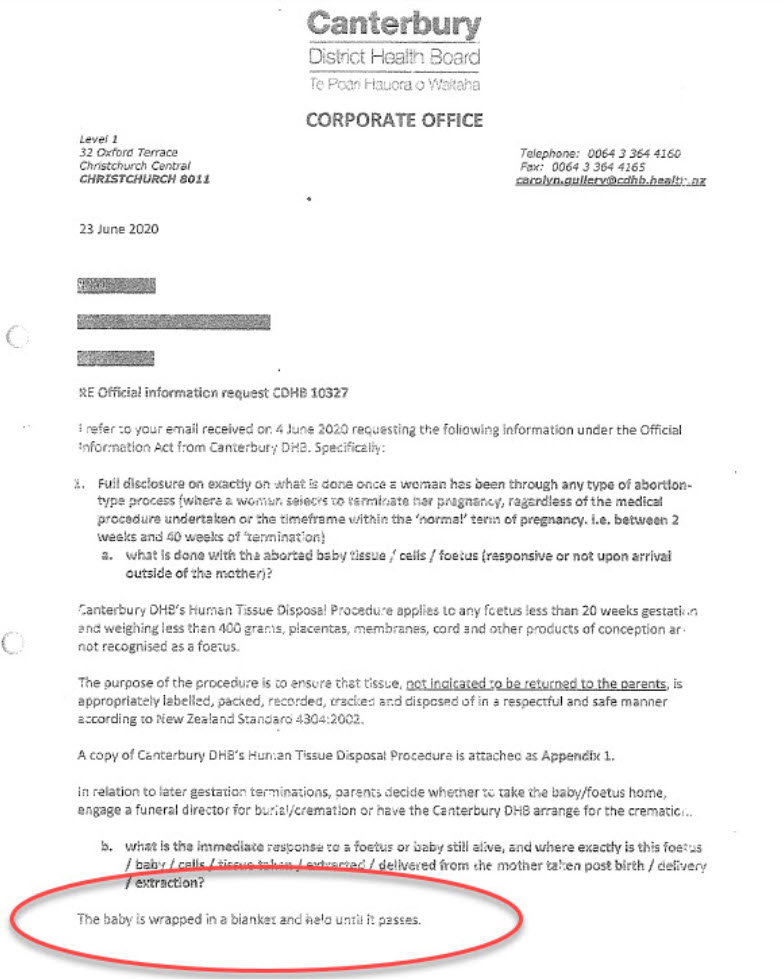
Canterbury have previously advised that the “baby is wrapped in a blanket and held until it passes”.
So for those who would argue that born alive abortions don’t happen, please explain why DHBs have specific policies for the possibility. I’ll come back to some of the other denial arguments that are being put up on this disturbing information.
What is also concerning is that some larger districts including Waitemata, Counties Manukau, Bay of Plenty, Waikato and Capital Coast & Hutt Valley refused to provide the data.
As we say in our media release, we are not surprised by this data – but it is still truly shocking. Whether the unborn child is 15, 20, 30 or 40 weeks in the womb, it will naturally be fighting for its life. That is our human instinct. We should be protecting the lives of innocent babies who survive attempted abortions. We should be making abundantly clear that this is an obligation on medical professionals.
Dr Joanna Howe is an pro life activist in Australia and she has explained one of the examples of how born-alive abortions may happen
The argument used to minimise this data by the pro-death cult will be two-fold. And we must not buy into it. It’s similar to the media. They don’t want to hear about it, they don’t want to acknowledge, and pardon the pun again, they don’t want to give the issue oxygen.
The arguments are “It’s very very rare if at all” and “it’s only for fetal abnormalities”.
Both are myths.
A recent study cohort study of almost 14,000 second-trimester abortions occurring in hospital settings between 1989 and 2021 – so a 32 year period – in Quebec, Canada found that among those 14,000 abortions between 15 and 29 weeks of gestation, 11.2% led to live birth. 11%!
Fetal anomaly was the indication for termination in just 48% of cases – less than half. 5% were due to maternal emergencies — cases where the mother’s life was at risk. But nearly half, 47%, were done for “other reasons:” personal, social, or simply unspecified.
So 1 in 10 in Quebec. Last year in Alberta it was one in five.
So – not rare. Not rare in any imagination.
Compared with abortion between 15 and 19 weeks, abortion between 20 and 24 weeks was associated with 4.80 times the risk of live birth.
The researchers concluded
“Second-trimester abortion carries a risk of live birth, especially at 20 to 24 weeks of gestation, although feticidal injection may protect against this outcome.” (our emphasis added)
This shocking data comes at the same time as recent studies reveal that active treatment and survival rates for babies born at 22 weeks and 23 weeks are increasing. Between 2014 and 2023, survival among 22-weekers who received active treatment rose from 25.7% to 41%. Rates of survival rose from 7.4% to 32% for babies born at 22 weeks who did not receive active treatment.
A 2025 study published by the Journal of the American Medical Association (JAMA) has revealed that both active medical treatment and the survival rate of babies born as early as 22 weeks are increasing.
And in fact, Lila Rose’s LiveAction organisation had a recent example that they highlighted
Baby Aaron, who was born weighing just one pound, one ounce at 22 weeks gestation, has beaten the odds and was discharged from a Las Vegas hospital to his home with his mother… after spending almost five months in the NICU at Sunrise Children’s Hospital in Las Vegas, Nevada. Studies show skin to skin contact known as Kangaroo Care is a “vital intervention in the neonatal intensive care unit.”
It’s not just NZ where there is the problem of born-alive abortions.
In Australia last year, according to a report in The Australian
A clinical midwife who has worked in maternity and birthing units for about 14 years, told a parliamentary hearing in Queensland that some babies born alive after an abortion were never held by their parents but instead placed in witches hats, taken out of the room and left to die. Ms Adsett, who works at a public hospital south of Brisbane, was providing evidence to a Queensland parliamentary inquiry into the Termination of Pregnancy (Live Births) Amendment Bill 2024 introduced by Robbie Katter aimed at enshrining legislated protections for babies born as a result of a termination of pregnancy procedure.
In an emotional statement to the hearing, Ms Adsett said some midwives were distressed because they were “unable to provide any medical care for the baby” but were “limited to providing comfort care only, which is merely wrapping and holding the baby”. “To give you a first example, a mother made a decision to abort a baby at 21-plus weeks’ gestation. The process began in the morning with misoprostol given throughout the day. The process took all day, and the baby was only delivered during the early hours of a night shift where skeleton staff was on duty,” Ms Adsett told the inquiry. “This baby moved vigorously, gasped for breath and had a palpable heart rate to make it clear this baby was alive. It was over 400 grams, but the baby was a good weight. The parents of this baby did not desire to see or hold this baby. Midwives and doctors were left holding this little life while they continued to provide cares for other women who were birthing and welcoming their babies into the world. This baby boy fought for his life for five hours before taking his final breath. This is not an uncommon occurrence.”
Ms Adsett told the inquiry that she was a “conscientious objector when it comes to providing care for women aborting their babies”, but said she was “happy to make myself available to hold a baby who was born alive after an abortion”. “These babies deserve better. They deserve to have the same rights that all of us human beings have,” she said.
In her submission to the inquiry, University of Adelaide law professor Joanna Howe noted there had been 328 babies born alive and left to die in Queensland between 2010 and 2020.
Even the rabidly left wing pro abortion The Guardian had to admit while trying to downplay the issue
According to the coroner’s report, in a small Darwin hospital, a foetus was unexpectedly born alive after a termination. There was confusion over the gestation age. The nurse present didn’t know what to do, and the treating doctor did not help her. The nurse wrapped the baby in a “warm rug” and constantly checked on it. But the coroner heard it would only have had an “extremely small” chance of survival no matter what. It died 80 minutes later. The coroner recommended protocols be put in place to prevent the rare event happening again.
Another case often mentioned is “Xanthe”. A Queensland couple decided to have a termination after they found out their daughter had Down’s syndrome. Xanthe was born alive. The father said they were not told and would have wanted to be with her when she died. The case was reportedly being investigated by the ombudsman, who declined to provide an update.
So they do happen.
In Ireland, an article in the Irish Times entitled We need to have a conversation about babies born alive after abortion refers to government reports which show that 84 born alive abortions occurred between 2019 and 2022. The report says
The 2023 three-year review on abortion called for guidelines to be developed on comfort care after a live birth following abortion
According to the Canadian Institute for Health Information (CIHI) — the federal agency responsible for compiling and reporting standardized health data across Canada — Alberta reported a total of 133 late-term abortions in the 2023-2024 year. Of those 133 late-term abortions, 28 babies were born alive after the procedure. In one year.
According to ABC News in 2023
The House of Representatives passed the Born-Alive Abortion Survivors Protection Act on Wednesday, with votes at 220-210. If approved, the legislation would require health practitioners to care for an infant that is born alive after a failed abortion, according to the law.
In order to become law, the bill would need to be approved in the Senate and signed by President Joe Biden, which is unlikely.
It didn’t get past the Senate – sadly
Senate Majority Leader Chuck Schumer, D-N.Y., said Wednesday that the bill, is… “doomed in the Senate” and “extreme.” “American women deserve to have their right to healthcare protected, not undermined,”
Note the terminology – Deserve their right to healthcare.
Failing to kill an unborn child can never be called “healthcare”.
The article says
Failed abortions where infants are born alive are extremely rare. In Minnesota, which tracks those cases, there were over 10,000 abortions performed in 2017 and only three cases where an infant was born alive, according to a department of health report.
So they DO happen. One case is one too many. And this is just one state.
In fact, if you go along with the line “they don’t happen” you deny the experience of Melissa Ohden – an abortion survivor who spoke at our Forum on the Family last year.
If you’ve watched the 2011 movie “October Baby” it is the story of a woman named Hannah, who learns as a young adult that she survived a failed abortion attempt. She then embarks upon a road trip to understand the circumstances of her birth. October Baby was inspired by the life experiences of Gianna Jessen, who was born after a failed abortion attempt. Gianna Jessen has since campaigned against abortion, saying
“It’s more comfortable for people to think of abortion as a political decision, or a right. But I am not a right. I am a human being”.
Rodney Hide also did a powerful interview on Reality Check Radio with a midwife who shares her firsthand account of a late-stage abortion that resulted in a baby being born alive—left without care, taking two agonising hours to die.
As I said earlier, the arguments “It’s very very rare if at all” and “it’s only for fetal abnormalities” are complete smokescreens.
See through them.
Babies are surviving abortions far more often than anyone wants to admit.
In 2020, an amendment to the radical and extreme Abortion Legislation Bill of Jacinda Ardern’s was introduced by my colleague Simon O’Connor who was a National MP at the time.
Remember that shocking bill that was rammed through Parliament while we were all going into lockdown to protect our most vulnerable fellow human beings from COVID – and meanwhile Parliament is debating how to liberalise laws around killing THE most vulnerable in our society – the unborn child. Truly shocking.
Simon’s amendment clarified that a qualified health practitioner who performed an abortion that results in the birth of a child after an attempted abortion has a duty to provide the child with appropriate medical care and treatment, no different than the duty owed to provide medical care and treatment to any other child born.
Irrespective of the attempt to abort the child. Irrespective of the intent of the abortionist. Irrespective of whether the baby was ‘wanted’ or not.
We are dealing with a human life who is fighting for life.
It was only supported by 37 MPs (less than a third). At the time of the debate in Parliament, then-Minister of Health & Labour MP Andrew Little said “I would like to see the science about a child being born after an abortion.”
Well, here is the evidence.
This is not about politics – this is about having a heart.
The vote against such a provision was actually just confirmation of how extreme and radical Jacinda Ardern’s abortion law was – and the agenda of its supporters.
Based on this disturbing evidence, we’re calling on the Government to immediately introduce and pass legislation which requires life-sustaining care of any child born alive after an attempted abortion.
But most importantly, give this issue oxygen.
If you hear people downplaying the occurrence, show them this episode and point them to the overwhelming research evidence and also the stories – as Melissa refers to.
It’s no surprise that the media have gone deathly silent.
But as William Wilberforce once said: “You may choose to look the other way, but you can never again say that you did not know.”
We must speak up for our most vulnerable. We must speak up for the unborn child.